
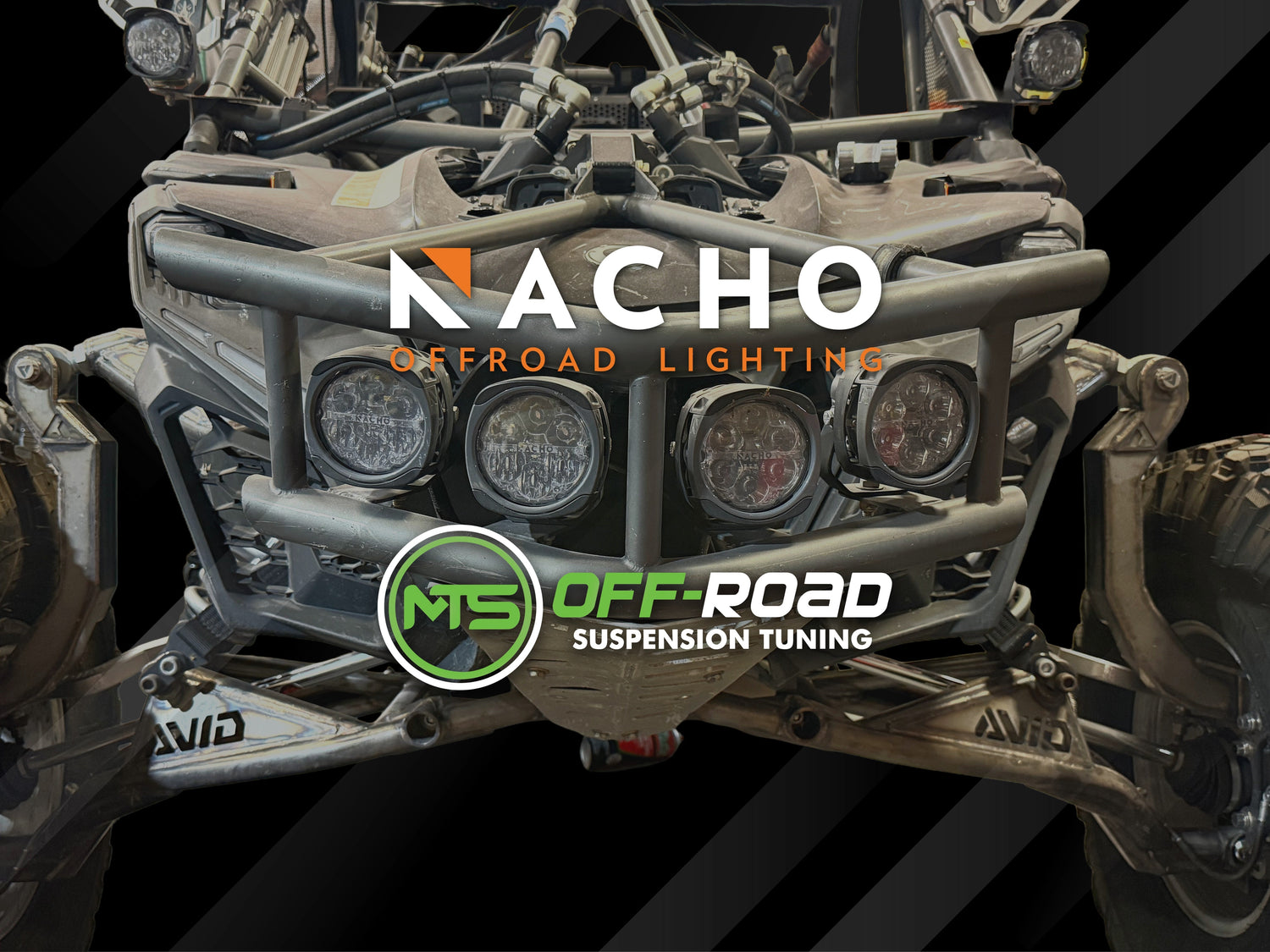
When you spend your days tuning UTV suspension for a living, you stop caring about brand loyalty and start caring about one thing: does it survive the next 200 miles. That's the standard every part has to clear at MTS Off-Road, whether it's going on a customer's RZR or our own race UTV, the Can-Am Maverick R. It's also the standard that decides our lighting setup. After running our Maverick R through deserts, dunes, and everything in between, we landed on one name for every light bar and pod on the car: Nacho Offroad Lighting.
This isn't a sponsorship blurb. It's the result of years tuning suspension and running our own Maverick R through some of the harshest terrain in North America, watching which components hold up when the sun goes down and the trail doesn't stop. Lighting is one of those parts that only gets noticed when it fails — and on a race UTV doing triple-digit speeds in pitch black, a light failure isn't an inconvenience, it's a hazard. So we tested. We ran other brands. And we kept coming back to Nacho.
Here's why.
The Problem With Off-Road Lighting (And Why Most Lights Don't Solve It)
Most off-road lights are built to do one job. A spot light throws a narrow, far-reaching beam for high speed. A flood light throws a wide, close beam for technical terrain. A scene light lights up your immediate surroundings for camp or recovery. Historically, if you wanted all three, you bought three different lights, wired three different switches, and found real estate on your UTV for three different housings.
On a race UTV, every one of those compromises costs you something — wiring complexity, failure points, weight, and mounting headaches on a chassis that's already crowded with cooling, suspension, and safety equipment. We needed lighting that could do more with less, hold up to the vibration and impact of desert racing, and not turn into a wiring nightmare mid-build.
That's the gap Nacho built their entire product line around, and it's the reason we standardized on their Quatro and Grande lights for our race program.
What Makes Nacho Different: Multi-Mode, Not Multi-Light
The core idea behind Nacho's lighting is simple: instead of one light doing one job, each Nacho light can be programmed to do several. Both the Quatro and Grande use what Nacho calls their Output Control Module paired with a "Tip-to-Chip" programming method — you tap the side of the light with a small magnetic tool (Nacho calls it the Sorcery Wand) and cycle through the available beam patterns until you land on the combination you want. Set it once, and the light remembers it.
That means a single Quatro or Grande pod can function as a spot light, a flood light, a wide-area scene light, or a low-power running light depending on how it's programmed — all without adding extra switches, extra wiring, or extra real estate on the UTV. On a competition build where every connector is a potential failure point and every ounce matters, that's a meaningful advantage over running multiple single-purpose lights to cover the same ground.

Both lights also share a few characteristics that matter a lot once you're actually racing instead of just driving at night:
IP68 waterproof and dustproof rating. Both the Quatro and Grande are sealed against water submersion and dust intrusion. In desert racing that mostly means dust — the kind that gets into everything — and in places like Glamis or coastal terrain, it means sand and moisture too. A light that lets dust into the housing is a light that's going to dim, flicker, or die exactly when you need it most.
J575 vibration rating. This is an automotive-industry standard for vibration resistance, and it matters more in off-road racing than almost anywhere else a vehicle operates. A UTV bouncing through whoops or washboard at speed puts sustained, brutal vibration into every bolted-on component. Lights that aren't built for it loosen, crack solder joints, or fail outright.
Exoskeleton Duct Cooling. Nacho's outer housings on both lights are engineered to pull air in through the front and exhaust it out the back, actively cooling the internals instead of just relying on a passive heat sink. LEDs lose output and lifespan as they heat up, so active cooling under sustained high-power operation is a real performance factor, not a marketing line.

Impact-resistant, replaceable housings. Off-road racing means rock strikes, roost from other vehicles, and the occasional hard landing. Nacho's polycarbonate housings are built to take that abuse, and critically, the outer shell is replaceable without replacing the whole light — so a cracked housing from a rock strike doesn't mean buying a new light, just a new shell.
Designed and built in the USA. Nacho engineers, tests, and assembles their lighting out of their Mesa, Arizona facility — close enough to home that when we've needed support or had a question about a build, it's been a phone call, not an overseas email chain.

The Quatro: Our Go-To for Compact, High-Output Lighting
The NACHO Quatro is a 4-inch pod light that punches well above its size. Their new tech allows more output with higher wattage in a compact enough size to mount almost anywhere on a UTV all while not taxing the power supply any extra— A-pillars, bumpers, chase racks, or as ditch lighting. It comes with more than 8 selectable modes per light, so depending on the optic and programming, a single Quatro pair can cover flood, spot, or combo duty.
We run Quatro lights in spots on our Maverick R where space is tight but we still need real output — places where a bigger housing simply won't fit or would create clearance problems with suspension travel, especially with the long-travel setup we run on our race UTV. The trade-off for size is intensity rather than total beam reach, which makes the Quatro a strong complement to a primary light rather than a standalone main beam on the fastest sections of a course.
It also runs Nacho's TRL (Trail Running Light) function — a low-power glow mode that keeps the car visible to others without blinding oncoming traffic or competitors, and that can be wired to a separate switch or tied into the car's factory running lights.
The Grande: Built for Desert Speed
If the Quatro is about doing a lot in a small footprint, the Grande is about raw distance and visibility at speed. At 6.75 inches and up to 140 watts depending on the variant, the Grande is the light we reach for when the priority is seeing as far down the course as possible at 80, 90, 100-plus miles an hour. It runs eight total available modes with three selectable at a time, covering spot, flood, area, and TRL functions from a single housing.
This is the light doing the heavy lifting on the front of our Maverick R — the one that has to perform identically whether we're running wide-open desert straightaway or technical sections where the beam needs to fill in the foreground without blinding the driver off washboard or whoops. The Grande's higher-wattage variants are explicitly built around race-speed visibility, and that's exactly the role it plays on our car.
Built for the Can-Am Maverick R
MTS Off-Road's race program is built around the Can-Am Maverick R, and the suspension and lighting decisions on our car aren't made independently of each other. We're a suspension shop first — shock tuning, spring kits, radius rods, and the rest of what we do all day — which means we understand better than most how much abuse a chassis and everything bolted to it takes during a real desert race. That perspective shaped how we think about lighting just as much as it shaped how we think about valving.
A Maverick R built for competition is going to see sustained high speed, hard landings, washboard, whoops, and long stretches where the only thing between the driver and a bad outcome is being able to see the terrain accurately. Lighting on a UTV like this isn't an accessory, it's a safety system, and we treat it that way in how we spec and mount Quatro and Grande lights on the car.
Proven, Not Just Promised
 It's one thing for a light to look good on a spec sheet. It's another for it to survive an actual season of racing. Here's where Nacho lighting has actually been tested on our car:
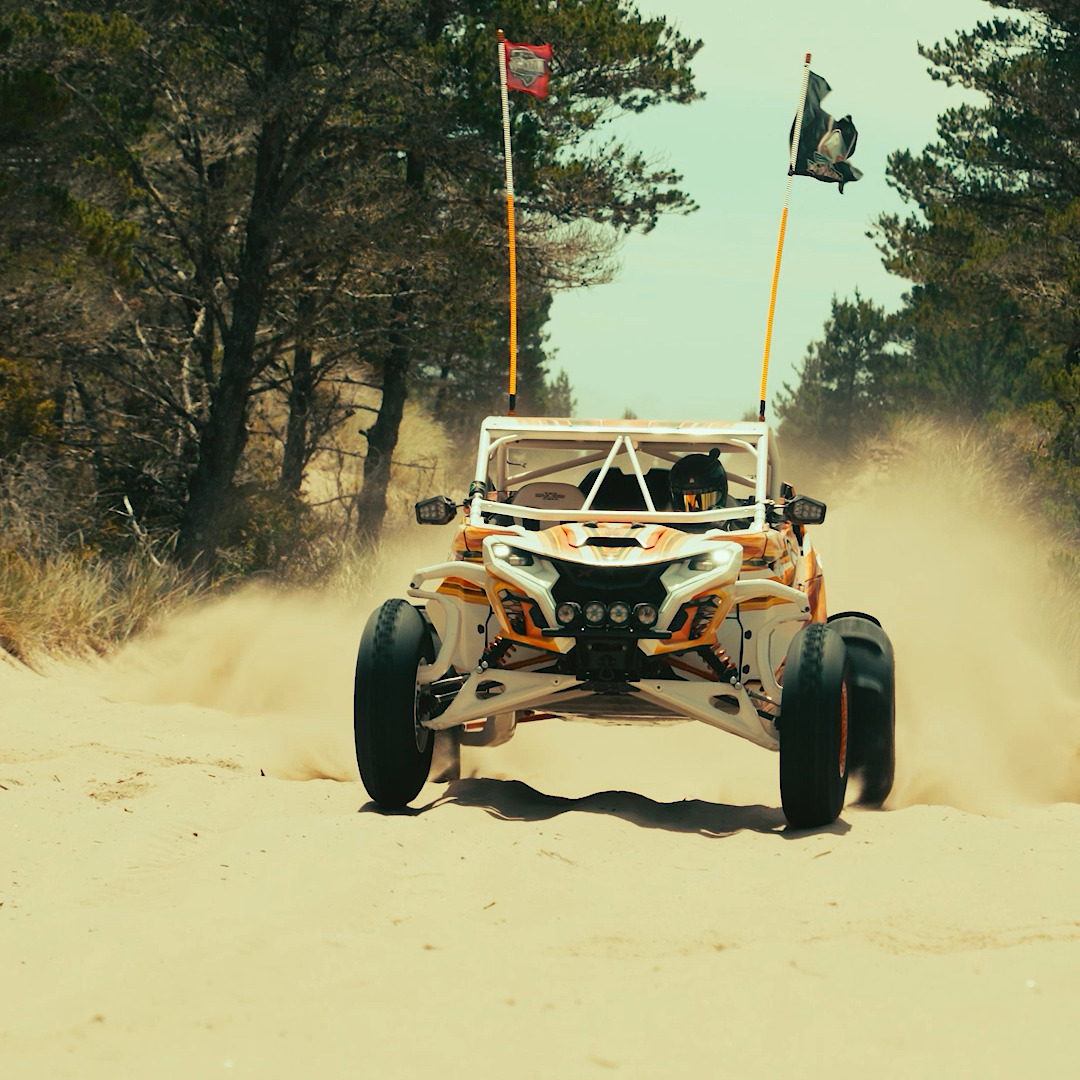
Glamis, California. We make the trip to the Glamis dunes every year for shock tuning, which means our race UTV and the lights mounted on it spend extended time in some of the harshest sand and dust conditions in the country. Fine sand finds its way into everything not properly sealed, and it's exactly the environment that exposes a weak IP rating fast.
A qualifying race across the border in Mexico. Last year, our team qualified at the SADR (Southern Arizona Desert Racing) Sonoyta 160 in Rocky Point, Mexico — a course that combined open desert sections with stretches of dunes. Those are different terrain demands within the same event, and a good test of whether a single lighting setup can handle both without compromise. The Nacho lights ran the full event without issue.
Coos Bay, Oregon. A completely different environment from the Sonoran or Mexican desert — coastal, often damp, with terrain and conditions that put a different kind of stress on lighting than dry desert dust does. Running the same lights through both environments without swapping equipment says something about how broadly capable the Quatro and Grande actually are.
Our main race UTV driver, Rex, has put these lights through all of it — dunes, desert, coastline — and the consistent feedback has been the same every time: the lights work exactly as programmed, every time, regardless of where we're racing.
Why We Don't Run Anything Else
We tried other lighting brands before settling on Nacho. We're not going to pretend otherwise, and we're not going to pretend every other light on the market is bad — there are a lot of capable products out there. But for what we need a light to do on a competition race UTV — survive sustained vibration, keep dust and water out without fail, run cool under sustained high output, and give us multiple beam functions out of a single housing without piling on extra wiring and failure points — Nacho's Quatro and Grande consistently came out ahead of everything else we tested.
 (NACHO Branded Covers, on top of Nacho Lights)
MTS Off-Road tunes suspension systems that have to survive real racing, not just look good in a parking lot, and we hold every other component on our race car to that same bar. Nacho's lighting cleared it. That's why our Maverick R runs their lights, and it's why we keep recommending them to customers building their own Maverick R, X3, or RZR for serious off-road use.
Where to Get Set Up
If you're building a race UTV or just want lighting that's actually proven in the terrain you run, check out the full Quatro and Grande lineups at Nacho Offroad Lighting, and if your build needs suspension to match, you know where to find us at MTS Off-Road.

Leave a comment
This site is protected by hCaptcha and the hCaptcha Privacy Policy and Terms of Service apply.